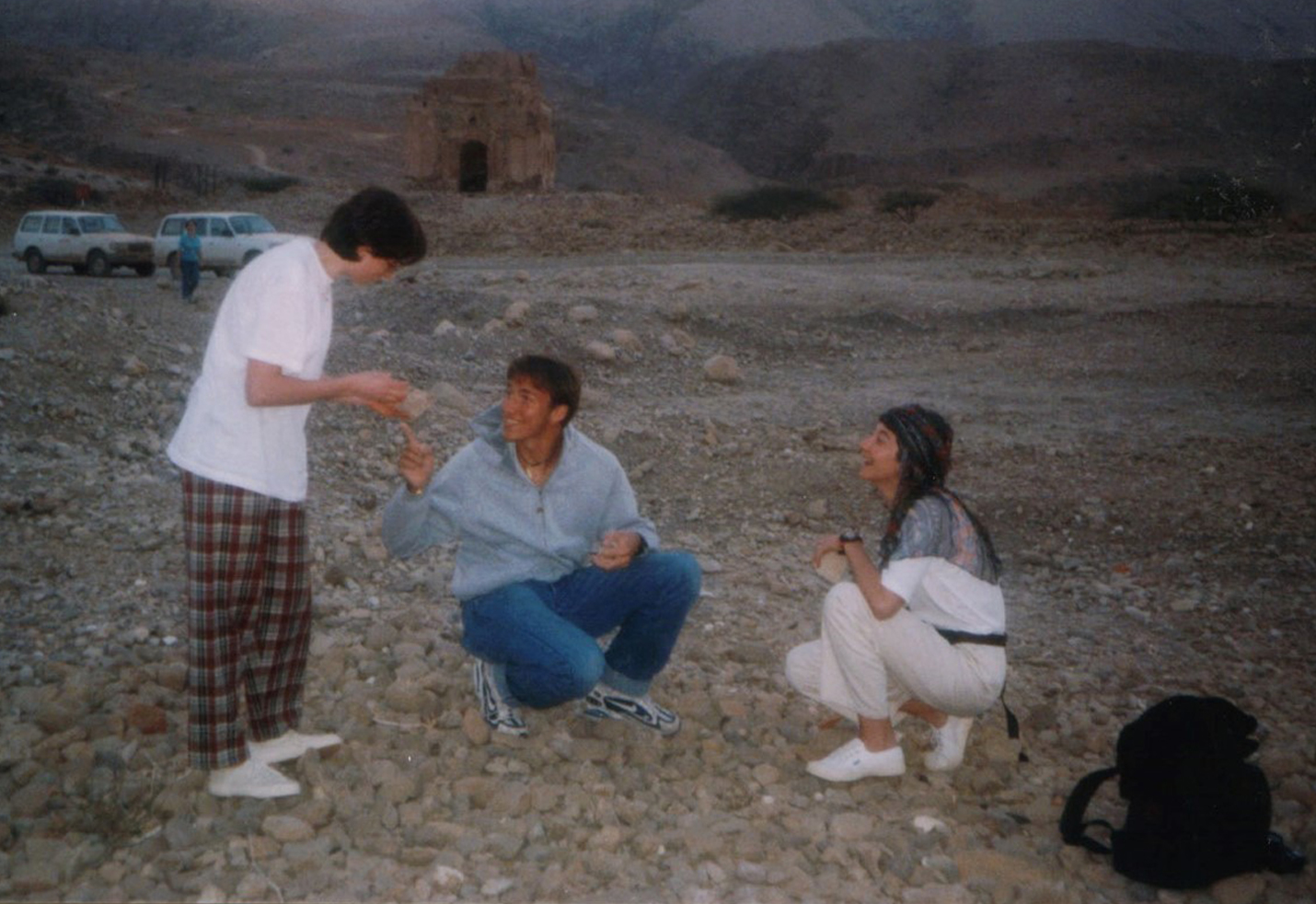
The Joint Hadd Project is a Italo-French archaeological mission in the Sultanate of Oman from 1985 to 2014, collaborating with the Ministry of Heritage and Tourism, focusing on the prehistoric, Bronze Age, and Iron Age coastal settlements of the Ras al-Hadd and Ras al-Jinz areas.
Until 2009, it was directed by two outstanding figures: by Maurizio Tosi, an Italian archaeologist and professor of Palethnology, first in Naples and at the University of Bologna, an exceptional communicator; he conducted major excavations in Europe, Asia, and South America; his research at the site of Shahr-i Sokhta, the “Burnt City,” in eastern Iran, was particularly fundamental.
And by Serge Cleziou, (CNRS, French archaeologist known for his pioneering contributions to the prehistory and Bronze Age archaeology of Southeastern Arabia, particularly in the United Arab Emirates and Oman.
Tosi and Cleziou are regarded as founding fathers of archaeological research in the region.
It is crucial for understanding the evolution of Arab civilization, the development of maritime trade, and the "Magan" (Oman) copper trade with Mesopotamia, revealing early maritime, industrial, and trading communities.
The work was very innovative: a multidisciplinary approach studying climate change, environmental adaptation, and the relationship between coastal and inland societies.
The project involved ISMEO (the Italian Institute for the Middle and Far East, later ISIAO, the Italian Institute for Africa and the Orient), the University of Naples “L’Orientale” and later the University of Bologna, with French partners (CNRS, Université Paris-Sorbonne), British partners (British Museum, London), and American partners (University of Wisconsin–Madison)
The project involved the University of Bologna, ISMEO, and has collaborated with the University of Wisconsin–Madison and French partners. The project has been instrumental in defining the "great transformation" of the 4th-3rd millennium BC in the region, marking the rise of complex, trade-oriented societies.
Italian research in Oman has never been interrupted and continues under the direction of several scholars, including Maurizio Cattani (University of Bologna).
Key Sites:
• HD-6A major 4th-3rd millennium BC settlement showing stone/mud-brick architecture and specialized shell/stone bead production.
• HD-1, HD-5: Coastal sites with evidence of fishing, maritime activities, and 3rd millennium BC Indus-related ceramics.
• RJ-2 (Ras al-Jinz): A significant Bronze Age site (Umm an-Nar period) with evidence of long-distance interaction.
Discoveries include fishing shelters, metal, shell, and bead workshops, pottery, and evidence of early bronze-age maritime, and trade-based economies.



 Profilo professionaleRicerche e progettiPubblicazioniInsegnamento e formazioneMedia e divulgazioneGalleria visualeCollaborazioni e networkContatti e servizi